
Apple Inc.: Building a Global Technology Ecosystem Through Innovation
How Apple transformed the technology industry through innovative products, premium design and a connected digital ecosystem.
5 min read · 52 views · By Shalini B
- Client / anonymised name
- Apple Inc.
- Industry
- Information Technology & Consumer Electronics
- Service type
- Product Innovation, Software Development & Digital Ecosystem
- Project type
- Business Strategy & Technology Transformation
- Region
- Global
In this case study
Executive summary
Apple Inc. is one of the world's most influential technology companies, recognized for its consumer electronics, software, digital services and customer-focused product experiences. Founded in 1976, Apple developed from a personal-computer business into a global technology company with products spanning smartphones, computers, tablets, wearables and spatial computing.Its strategy combines hardware, software and services in a connected ecosystem.
Introduction
The technology industry changes rapidly as customer expectations, devices and digital services evolve. Companies must continually improve products, adopt relevant technologies and deliver dependable experiences to remain competitive.
Apple is a prominent example of a company that competes not only through technical specifications but also through the overall experience created by its devices and services. Its design language, operating systems, retail experience and connected ecosystem contribute to a consistent brand identity.
Company Background
Apple was founded on April 1, 1976, by Steve Jobs, Steve Wozniak and Ronald Wayne. Its early goal was to develop personal computers that made computing more accessible. The Apple I was introduced in 1976, followed by the Apple II, which helped establish the company in the personal-computer market.
In 1984, Apple introduced the Macintosh, bringing a graphical user interface to a wider audience. The company later expanded into digital music with the iPod and iTunes, smartphones with the iPhone, tablets with the iPad, and wearable technology with Apple Watch. It now earns revenue from both products and services.
Major Milestones
Year | Major development |
|---|---|
| 1976 | Apple was founded. |
| 1977 | Apple II was introduced. |
| 1984 | Macintosh was launched. |
| 2001 | iPod was introduced. |
| 2007 | The first iPhone was launched; the company became Apple Inc. |
| 2010 | The first iPad was introduced. |
| 2015 | Apple Watch entered the market. |
| 2020 | Apple introduced the M1 chip and began transitioning Mac computers to Apple Silicon. |
| 2024 | Apple Vision Pro was introduced and Apple announced Apple Intelligence. |
These milestones illustrate Apple's expansion from a personal-computer manufacturer into a diversified technology company.
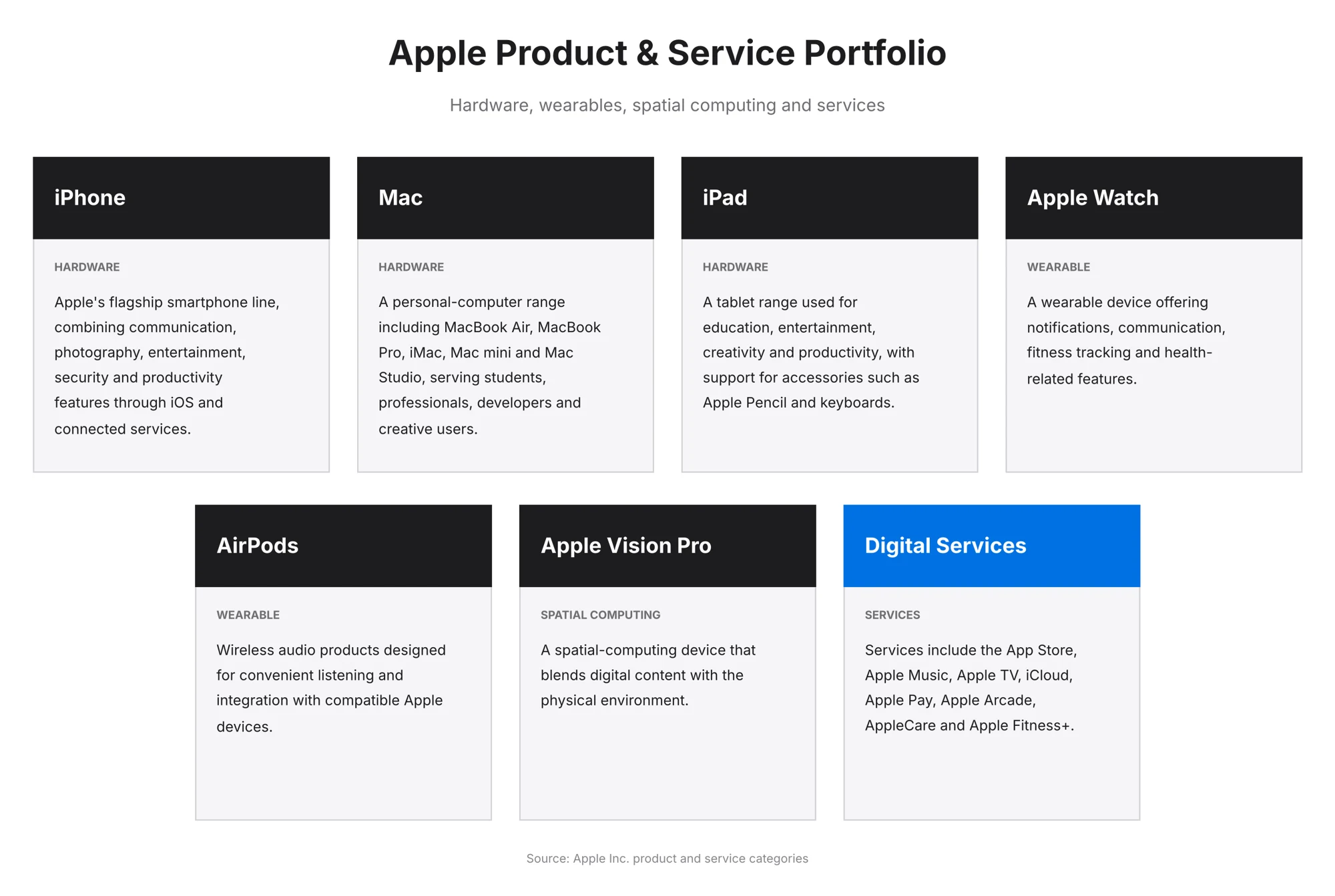
Products and Services
Business Model
Apple's business model combines premium hardware sales, software development and digital services. Its main components are :
- Product sales: Revenue from smartphones, computers, tablets, wearables and accessories, positioned primarily in the premium market.
- Services revenue: Income from subscriptions, digital content, cloud storage, advertising and support services.
- Integrated ecosystem: Products and services are designed to work together. For example, users can synchronize files through iCloud and use supported continuity features across devices.
- Direct and indirect sales: Apple reaches customers through its website, Apple Stores, authorized resellers, telecommunications partners and other retail channels.
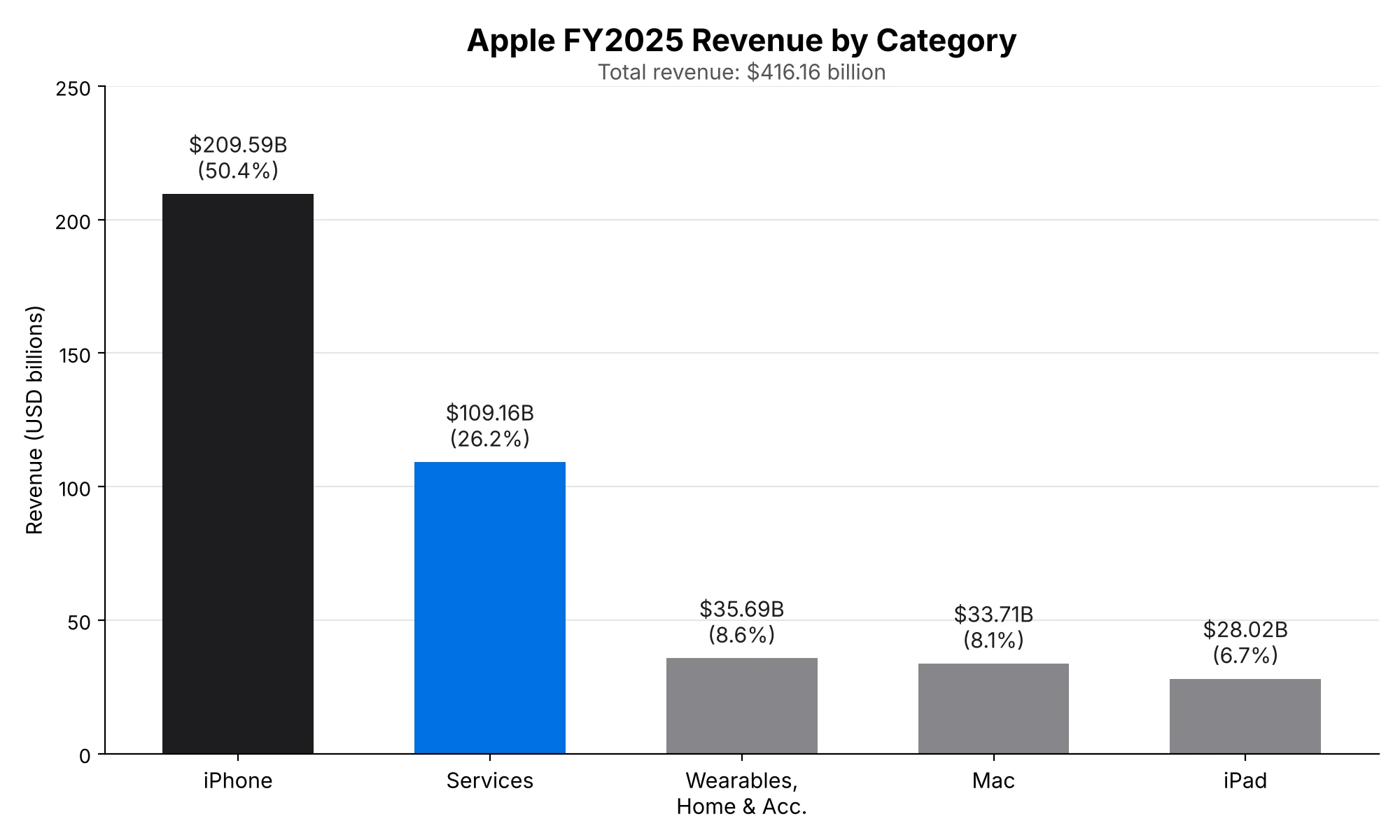
Revenue and Business Performance
Marketing Strategy
Premium branding : Apple positions its products as premium technology solutions, emphasizing design, performance, convenience and brand value.
Simple and clear advertising : Its marketing commonly uses clean visuals, concise messaging and product demonstrations to make features easy to understand.
Product launch events : Launch events introduce devices, software updates and technology developments, generating attention among customers and media.
Customer loyalty : The connected ecosystem, customer support and consistent product experience encourage long-term relationships.
Retail experience : Apple Stores allow customers to explore products, attend demonstrations and receive technical assistance.
Technology and Innovation
Apple
Silicon : Apple's custom chip designs, including M-series processors, provide
greater control over hardware and software integration.
Operating
systems : Apple develops iOS, macOS, iPadOS, watchOS and visionOS for its
product categories.
Artificial
intelligence : Apple Intelligence and machine-learning capabilities are being
integrated into supported products to assist with tasks such as writing,
communication and information processing.
Privacy
and security : Apple emphasizes privacy controls, app permissions, encryption and
secure authentication as parts of its product experience.
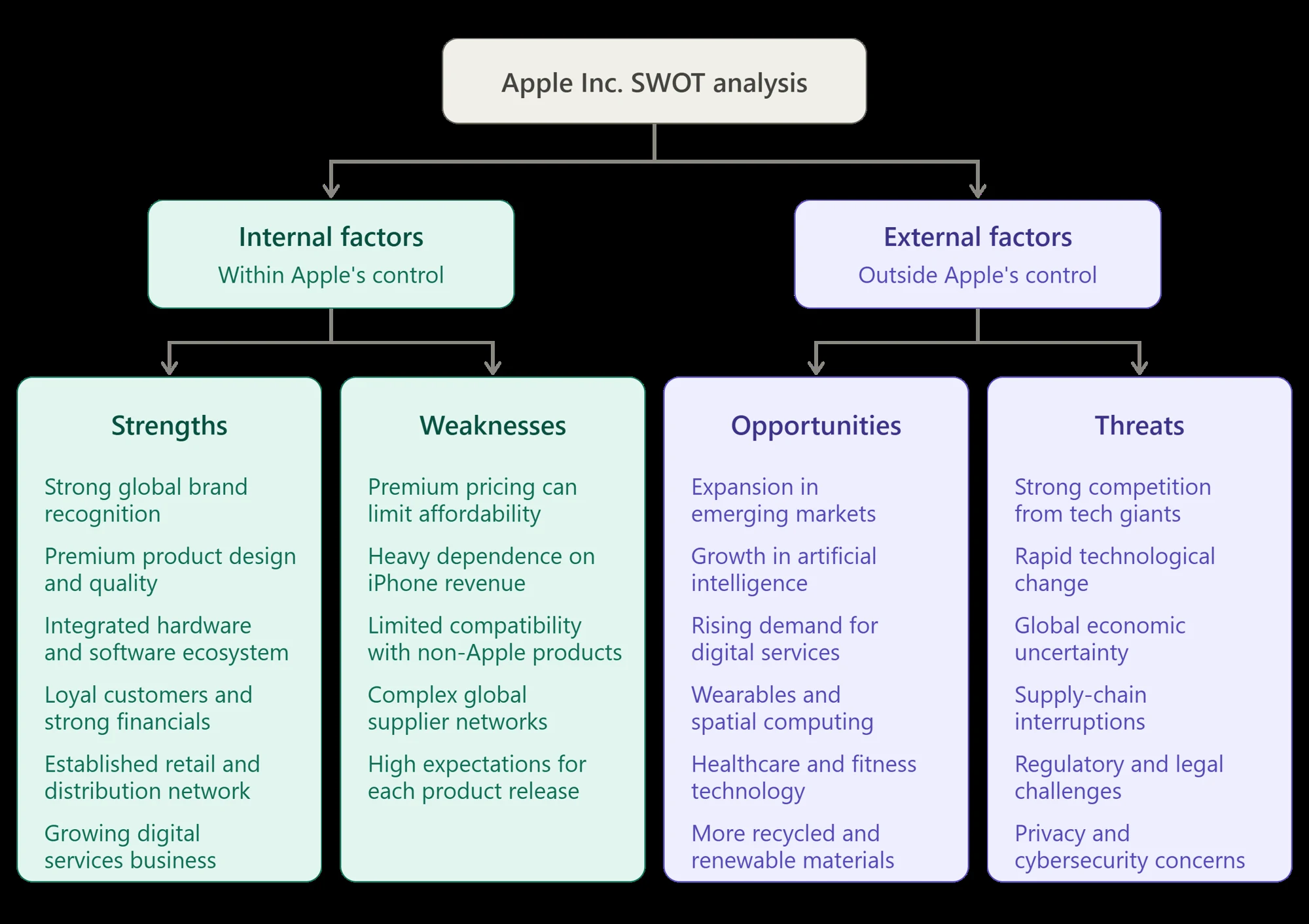
Major Challenges
Intense
market competition : Apple competes with companies such as Samsung, Google and Microsoft
across different technology markets. Competitors continually introduce products
and features.
Premium
pricing : Premium pricing can make Apple products less accessible to
price-sensitive customers, particularly in developing markets.
Supply-chain
management : Apple depends on international suppliers and manufacturing partners.
Geopolitical conditions, trade restrictions, component shortages and
transportation issues can affect availability and costs.
Technological
changes : Developments in artificial intelligence, mobile computing and
digital services require continued investment in research and development.
Strategies for Future Growth
- Expand AI capabilities to improve productivity, personalization and device interaction.
- Strengthen presence in emerging markets through suitable product offerings, financing options and distribution strategies.
- Improve sustainability by increasing recycled-material use, energy efficiency and product-recycling initiatives.
- Expand digital services, cloud offerings, entertainment platforms and subscriptions.
- Continue investing in spatial computing, wearable devices, custom processors and advanced software.
Key Business Lessons
1. Innovation creates competitive advantage: Businesses should improve products and services in response to changing customer expectations.
2. Customer experience matters: Products should perform well while remaining understandable and convenient to use.
3. Strong branding builds recognition: Consistent design, communication and quality help establish a recognizable identity.
4. Integrated ecosystems create value: Connected products and services can improve satisfaction and long-term engagement.
5. Adaptability is essential: Businesses must recognize emerging technologies and adjust their strategies.
6. Revenue diversification can improve resilience: Combining product sales with services and subscriptions creates multiple income sources.
Conclusion
Apple's journey from a personal-computer startup to a global technology company demonstrates the importance of innovation, strategic planning, product quality and customer experience. Its position is supported by premium products, integrated software, digital services and a recognizable brand identity.
The company continues to face challenges such as competition, pricing pressure, supply-chain complexity and rapid technological change. Its ability to adapt and invest in relevant technologies will remain important to future growth. Apple's experience offers useful lessons in combining technology, business strategy and customer-focused innovation.
Frequently asked questions
What is Apple Inc. known for?
Apple is known for its innovative consumer electronics, software, digital services and integrated technology ecosystem.
What are Apple's major products?
Its major products include iPhone, Mac, iPad, Apple Watch, AirPods and Apple Vision Pro.
What makes Apple's business model unique?
Apple combines hardware, software and digital services into an integrated ecosystem that creates a consistent customer experience.
What are Apple's major competitors?
Apple competes with companies such as Samsung, Google and Microsoft across different technology markets.
What are the key lessons from Apple's success?
Innovation, customer satisfaction, premium branding, product quality and business adaptability are important lessons from Apple's journey.

Shalini B
Founder & CEO